
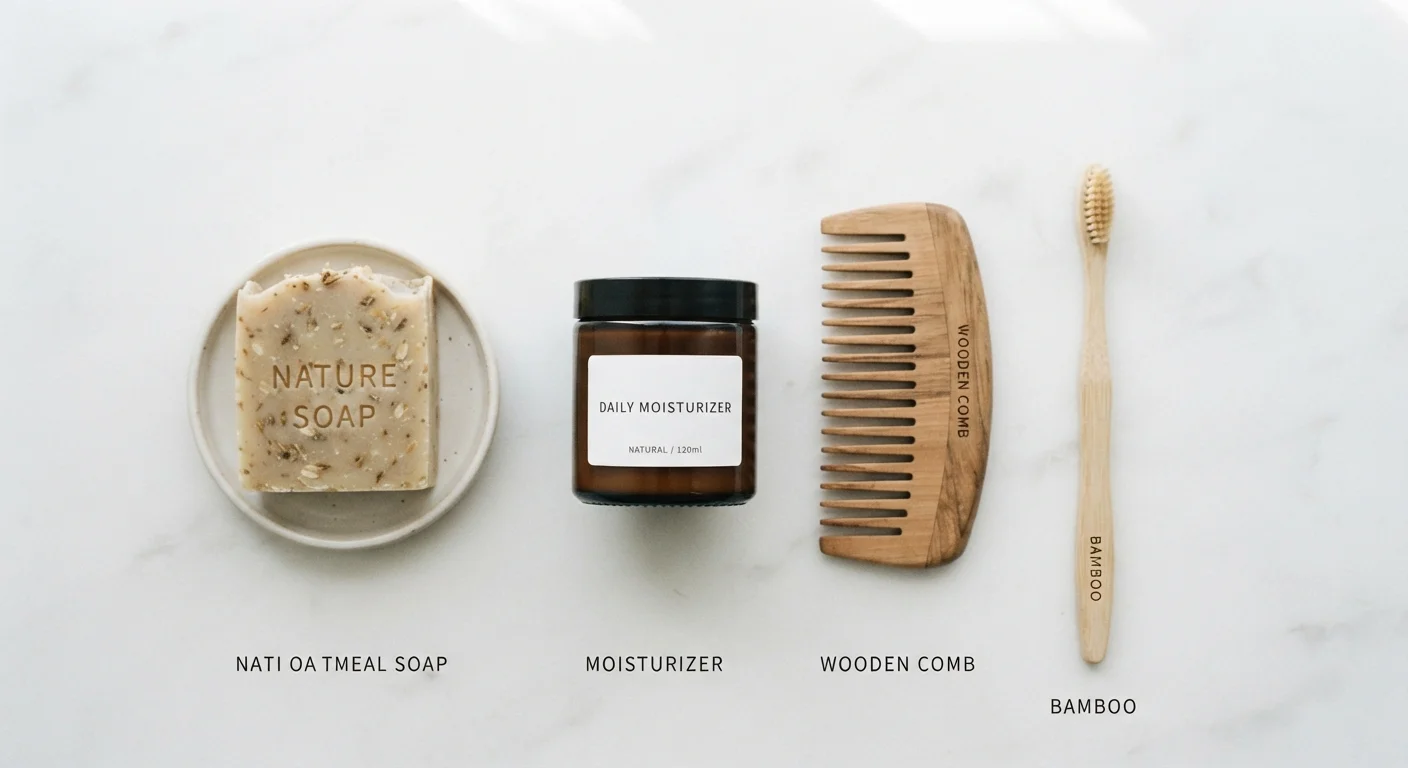
Why Personal Care Feels Overwhelming (And Why It Doesn't Have To)
Open any social feed and you'll encounter multi-step routines, specialty serums, and the confident suggestion that a dozen products are the bare minimum. It's a lot — and for someone just starting out, it can feel like the bar is impossibly high before you've cleansed your face once.
Here's the reality: personal care is fundamentally about hygiene, health, and comfort. The elaborate versions are optional additions, not prerequisites. Most of the benefit comes from a handful of consistent habits, not from an overflowing bathroom shelf.
This guide is designed to give you a grounded, clutter-free starting point — one that works regardless of your budget, background, or how much time you have. No shaming, no pressure, no assumption that you're behind.
Skin barrier
The outermost layer of the skin that acts as a protective shield, keeping moisture in and irritants out. Keeping it intact is a core goal of basic skin care.
Habit stacking
A technique where you attach a new habit to an existing one — for example, flossing right before brushing — to make it easier to remember and repeat.
Patch test
Applying a small amount of a new product to a small area of skin (typically the inner arm) and waiting 24 hours to check for any irritation or allergic reaction before using it more broadly.
Scalp
The skin covering the top of the head. It has its own care needs separate from hair strands, including managing oil production and preventing buildup.
Cleanser
A product used to wash the skin, removing dirt, oil, and environmental residue without unnecessarily disrupting the skin's natural moisture balance.
The Four Pillars of Basic Personal Care
Think of personal care as four interconnected areas. You don't need to master all of them simultaneously — but knowing what they cover helps you prioritize.
1. Skin
Your skin is your body's largest organ and its first line of defense. At the beginner level, skin care means cleansing to remove sweat, oil, and environmental residue, and moisturizing to support the skin barrier. Sunscreen, when going outdoors, is one of the most well-supported additions you can make. For a deeper look at how these areas connect, see the complete personal care overview.
2. Hair and Scalp
Healthy hair starts with a healthy scalp. Regular washing removes buildup; the right frequency depends on your hair type and lifestyle. Curious about ingredients in what you're using? Our plain-language ingredient reference is a helpful companion. For hair-specific guidance, the hair care starting point breaks it down by hair type.
3. Oral Health
Brushing twice a day with fluoride toothpaste and flossing daily are the cornerstones of oral health. The American Dental Association recommends these as the minimum effective baseline — and they're free of complexity.
4. Nails
Basic nail care involves keeping nails trimmed, clean, and dry. This isn't about aesthetics alone — it reduces the risk of bacteria buildup and minor injuries.
Building a Starter Routine That Actually Sticks
The biggest obstacle to personal care isn't knowledge — it's consistency. Routines succeed when they're short, predictable, and attached to something you already do.
Start With Two Weeks, Not Forever
Committing to a full lifetime routine can feel paralyzing. Instead, try your basic routine every day for just two weeks. That's enough time to see whether a habit is workable and to adjust anything that isn't fitting your schedule or skin. Small experiments build lasting habits far more reliably than grand overhauls.
Habit stacking is a useful technique: add a new behavior immediately before or after an existing one. Cleanse your face right after your morning shower. Floss right before you brush. These small anchors remove the decision-making and make habits almost automatic over time.
A realistic beginner framework might look like this:
- Morning (5 minutes): Cleanse face, apply moisturizer, brush teeth
- Evening (5 minutes): Cleanse face, moisturize, brush and floss
- Weekly: Shampoo as needed for your hair type, trim nails as needed
That's it. Everything else — exfoliants, treatments, specialty products — can wait until these basics feel effortless. For days when life accelerates, our guide to routines that hold up when life gets busy has stripped-back options that still cover the essentials.
If you're looking for a structured approach designed specifically for men's grooming, the realistic morning and evening grooming routine is a practical place to start.
Common Beginner Mistakes to Sidestep
Most early personal care missteps aren't about skipping steps — they're about overdoing things.
Don't Let 'More' Become Your Default
Skin irritation, dryness, and breakouts are frequently caused by using too many active products at once, not by using too few. When starting out, introduce one new product at a time, spaced at least a week apart, so you can identify what's helping and what isn't. If irritation persists, stop using the product and consult a dermatologist.
- Over-washing: Cleansing your face or washing your hair too frequently can strip natural oils and cause dryness or irritation. More is not always better.
- Skipping patch tests: Before applying a new product to your face or scalp, test a small amount on your inner arm for 24 hours to check for reactions.
- Chasing trends before understanding your own needs: Viral routines are designed for visibility, not necessarily for general skin or hair types. Learn what your own skin responds well to first.
- Neglecting the scalp: Many people focus entirely on their hair strands and forget that the scalp is skin that needs its own attention. Our scalp health explainer covers why this matters.
If you ever want to decode the ingredient lists on the products you're using, reading a skincare ingredient list without a chemistry degree makes that process straightforward.
Where to Go From Here
Once your basic routine feels natural — meaning you're doing it most days without much thought — that's the right moment to explore. You might add an exfoliant, investigate your scalp health more closely, or expand into a more complete grooming practice.
Personal care doesn't exist in isolation, either. How you feel physically and how you feel mentally tend to reinforce each other. If you're also building foundational wellness habits, our mental wellness guide covers that territory in a similarly grounded way.
For a comprehensive view that ties skin, hair, nails, and oral health together into one coherent picture, the full picture on personal care is the natural next step from here.
Start small. Be consistent. Build from what works. That's really the whole strategy.
This article provides general personal care information for educational purposes only and is not a substitute for advice from a qualified healthcare or skincare professional. If you have concerns about a skin condition, scalp issue, or oral health symptom, please consult a licensed professional.