
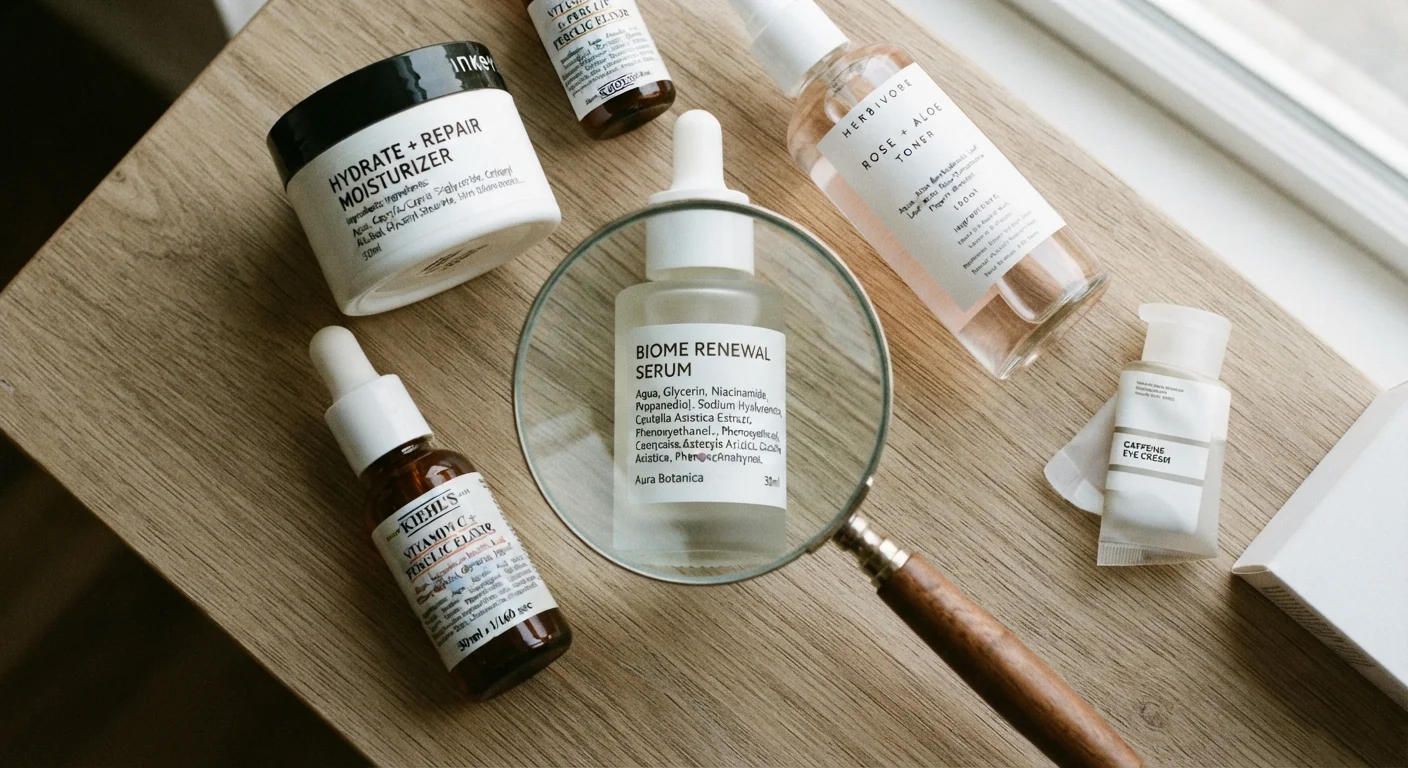
Why Ingredient Lists Look So Intimidating
Skincare labels weren't designed to be reader-friendly — they were designed to be legally compliant. The result is dense text using Latin botanical names and multi-syllable chemical terms that can feel designed to exclude rather than inform. But the structure underneath is actually logical, and learning it once pays off every time you pick up a new product.
If you're just starting to build a personal care routine, our beginner's guide to personal care is a great companion read. And if you want to understand how each product fits into a sequence, check out the anatomy of a daily skincare routine.
What you will need
The tools below will help you work through any label systematically.
Product with Ingredient List
The label you will be reading and evaluating during this exercise.
INCI Ingredient Lookup Tool
A free online database to decode unfamiliar chemical or Latin ingredient names.
Notepad or Notes App
Useful for recording ingredients you want to research or avoid in future products.
How to Read the List: Step by Step
Following these steps gives you a repeatable process you can apply to any product — drugstore or otherwise. There's no need to decode every word; the goal is to understand the structure and spot what's relevant to your skin.
Understand the INCI Naming System
Every skincare and personal care product sold in the US must list ingredients using INCI names — a standardized international system. This is why the same plant extract might read as Butyrospermum Parkii instead of shea butter, or Tocopherol instead of vitamin E. The Latin or chemical name isn't meant to confuse you; it's designed to be consistent across every brand worldwide.
Once you recognize that INCI is a standardized convention, the list becomes less of a wall of jargon and more of a structured reference.
Read the List Top to Bottom by Concentration
Ingredients are required by the FDA to appear in descending order of concentration. The ingredient present in the greatest amount comes first; the one present in the smallest amount comes last. This means the first five or so ingredients make up the bulk of what you're actually applying to your skin.
Water (Aqua) at position one is standard and signals a water-based formula — this is normal, not a sign of poor quality. Thickeners, emollients, and emulsifiers typically follow.
Identify the 1% Threshold
Manufacturers only have to list ingredients in concentration order down to 1%. Everything present at or below 1% can appear in any order the brand chooses. This is why you'll often see a cluster of actives, preservatives, and fragrance components grouped toward the end of the list — they may all be present at trace levels.
This threshold matters because it explains why a trendy ingredient splashed across the front of the packaging might appear near the very end of the ingredient list.
Flag Ingredients That Matter to Your Skin
Rather than trying to evaluate every ingredient, focus on your specific priorities. Common things readers look for include:
- Preservatives (e.g., phenoxyethanol, sodium benzoate) — needed to prevent microbial growth in water-based products
- Fragrance or Parfum — a single term that can represent many undisclosed compounds; relevant if you have reactive skin (see our article on fragrance on ingredient labels)
- Emollients and occlusives (e.g., glycerin, dimethicone) — help skin retain moisture
- Exfoliating acids (e.g., lactic acid, salicylic acid) — affect skin cell turnover and can cause sensitivity
Look Up What You Don't Recognize
You don't need to memorize ingredient chemistry. When something is unfamiliar, a quick search in a reputable INCI database will tell you its function (humectant, surfactant, pH adjuster, etc.) and any notable considerations. Keep a short personal list of ingredients your skin has responded well or poorly to — over time, this becomes your most useful reference.
Use a Reliable Ingredient Database
Free online tools maintained by cosmetic chemists and dermatology organizations let you look up any INCI name and see what it does and how it's typically used. Bookmark one so you can cross-reference unfamiliar terms as you shop. Our plain-language ingredient reference is a good starting point.
Ingredient Lists Are Not Medical Advice
Understanding an ingredient list helps you make informed product choices, but it does not replace guidance from a dermatologist. If you have a known skin condition, allergies, or persistent reactions, consult a qualified healthcare professional before changing your skincare routine.
"Free-From" Claims Aren't Regulated Uniformly
Labels like "paraben-free" or "sulfate-free" are marketing terms, not legal guarantees. They tell you one ingredient is absent but say nothing about the overall formulation. Always read the full ingredient list rather than relying solely on front-of-pack claims.
For a deeper look at what individual ingredients actually do, the plain-language ingredient reference covers the most common ones in plain English. And if you're navigating label reading with melanin-rich skin in mind, skincare across skin tones adds important context. It's also worth knowing that natural and synthetic ingredients both have trade-offs — the ingredient list is your best tool for cutting through marketing language and seeing what's actually in the bottle.