
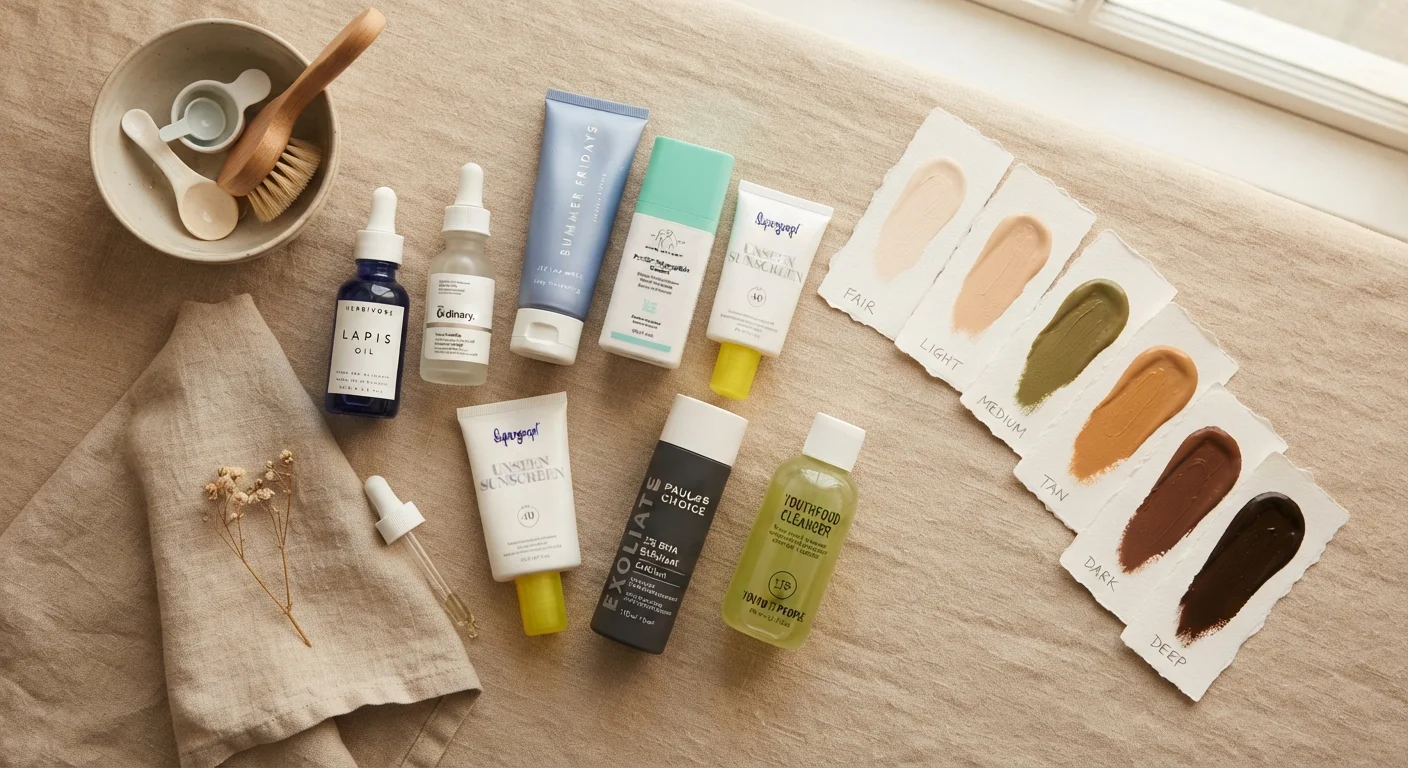
Why Skin Tone Changes the Skincare Conversation
Inclusive personal care isn't about treating every skin tone the same — it's about understanding how they differ so each person can make informed choices. The key driver of that difference is melanin, the pigment produced by cells called melanocytes. More melanin means more natural UV absorption, but it also means skin reacts to injury, inflammation, and sun exposure in distinct ways.
| Melanin types | Eumelanin (brown/black) and pheomelanin (red/yellow) (Dermatology textbook consensus) |
| UV protection from melanin | SPF 2–4 equivalent natural protection in very deep skin tones (Journal of Investigative Dermatology, general research) |
| PIH prevalence | Significantly more common in Fitzpatrick skin types IV–VI (American Academy of Dermatology) |
| Skin cancer misdiagnosis risk | Higher late-stage diagnosis rates in patients with darker skin (American Cancer Society, general findings) |
| Keloid risk | 5–15x more likely in Black and Hispanic populations vs. white populations (Dermatologic Surgery, general research) |
| Sunscreen gap | Darker-skinned individuals report lower consistent sunscreen use (JAMA Dermatology, survey data) |
One of the most significant differences is how inflammation shows up. On deeper skin tones, redness — the classic sign of irritation — is often masked. Instead, irritation may appear as ashen or gray undertones, or simply as persistent dryness. This can delay recognition of conditions like eczema or contact dermatitis, making attentive observation of your own skin essential.
The Fitzpatrick scale, a six-point phototype system developed for clinical use, categorizes skin by its UV response — from very fair (Type I) to very dark (Type VI). It's a useful reference point, though it's a tool, not a complete picture of your skin's needs. Your skin type — oily, dry, combination, or sensitive — is an entirely separate factor that layering atop tone awareness helps you address more precisely.
Key Concerns by Skin Tone and What They Mean for Routine
Certain skin concerns show up more frequently — or more intensely — across the melanin spectrum. Knowing the most common ones helps you build a proactive routine rather than a reactive one.
Melanin
The pigment produced by melanocytes that gives skin, hair, and eyes their color. Higher melanin concentrations generally offer some natural protection against UV radiation but also influence how skin responds to inflammation and injury.
Post-inflammatory hyperpigmentation (PIH)
Darkening of the skin that occurs after inflammation or injury — such as acne, a rash, or a cut — as excess melanin is deposited during healing. PIH is more pronounced and longer-lasting in deeper skin tones.
Transepidermal water loss (TEWL)
The rate at which water evaporates through the outermost skin layer. Research suggests darker skin tones may have lower TEWL on average, but individual variation means moisturizing remains important for all tones.
Broad-spectrum SPF
A sunscreen rating indicating protection against both UVA rays (linked to aging and pigmentation) and UVB rays (linked to burning). All skin tones benefit from broad-spectrum protection, though the risks manifest differently.
Hyperpigmentation
An umbrella term for areas of skin that appear darker than the surrounding tissue, caused by excess melanin production triggered by sun exposure, hormonal changes, or skin trauma.
Keloid
An overgrowth of scar tissue that extends beyond the original wound boundary. Keloids are more common in people with darker skin tones and require careful management to avoid triggering new ones.
Post-inflammatory hyperpigmentation (PIH) is one of the biggest concerns for deeper skin tones. When skin heals from acne, a rash, or even aggressive exfoliation, it often deposits extra melanin, leaving dark marks that can linger for months. This makes gentle cleansing and targeted actives (like niacinamide or azelaic acid, as noted in general dermatological guidance) relevant considerations — though any new active ingredient should be introduced slowly. Our guide to reading ingredient lists can help you decode product labels confidently.
Keloid scarring means that aggressive treatments — certain chemical peels, laser procedures, or even vigorous extractions — carry more risk for people with deeper tones. Consulting a board-certified dermatologist before any in-office procedure is especially important.
Sunscreen is non-negotiable across all tones. Melanin provides minimal natural UV protection — roughly SPF 2 to 4, far below dermatologist-recommended minimums. In deeper tones, UV damage tends to manifest as hyperpigmentation rather than visible burning, which can create a false sense of security. Broad-spectrum SPF 30 or higher is the general recommendation from major dermatological bodies for daily use. A structured daily routine that closes with SPF application is a practical foundation regardless of skin tone.
SPF 2–4
Natural UV protection from melanin alone
Research in the Journal of Investigative Dermatology indicates that even high-melanin skin provides only modest UV protection — far below dermatologist-recommended SPF 30 or higher.
5–15x
Higher keloid likelihood in darker skin tones
Studies in Dermatologic Surgery note that people with darker skin tones face substantially elevated risk of keloid scarring compared to lighter-toned counterparts.
This article is for general informational purposes only and does not constitute medical or dermatological advice. For personal skin concerns, consult a qualified, board-certified dermatologist.