
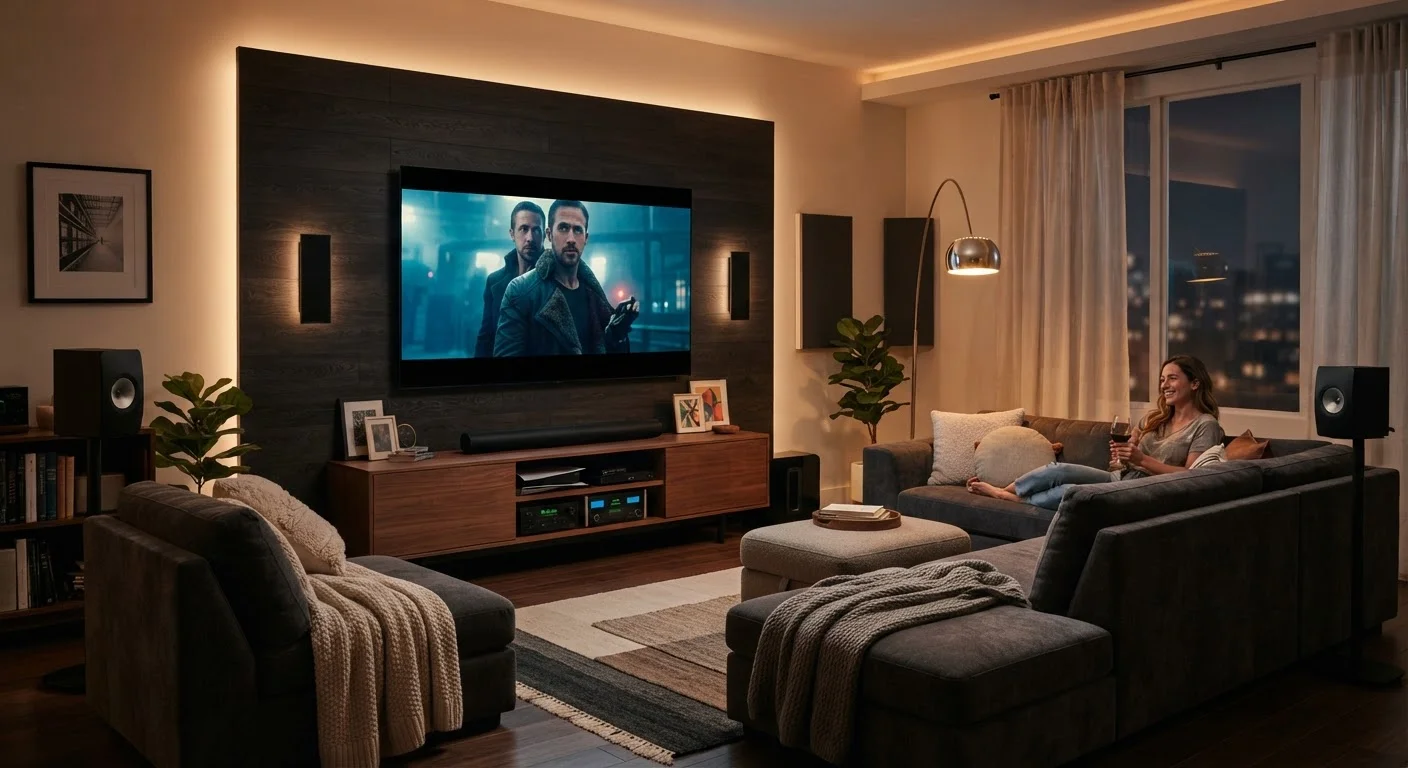
Why TV Audio Almost Always Needs Help
Modern televisions are thinner than ever, and that sleek profile comes at a cost: there is very little physical space inside for speakers. Flat-panel TVs often push sound downward or backward, making dialogue hard to follow and action scenes feel flat. An external audio system — whether a soundbar or a full surround setup — is almost always a meaningful upgrade over built-in TV speakers.
The question isn't really whether to add external audio, but which kind. Understanding the practical differences between these two approaches will help you avoid overspending on complexity you don't need — or under-buying and wishing you'd done more. For context on how your TV's picture technology pairs with audio, see what 4K and HD really mean for your living room.
Soundbars: What They Are and Who They Suit
A soundbar is a single elongated speaker unit — sometimes paired with a separate wireless subwoofer — that sits below your TV or mounts to the wall. It combines multiple speaker drivers into one enclosure to simulate a wider, fuller sound field than TV speakers can produce.
Strengths:
- Minimal cable clutter — typically one HDMI or optical connection to your TV
- Fast, approachable setup that most households can handle without professional help
- Compact footprint suitable for apartments, bedrooms, and medium-sized living rooms
- Many models support virtual surround processing, which creates a sense of spatial audio without physical rear speakers
Limitations:
- Virtual surround effects can sound unconvincing in larger or irregularly shaped rooms
- Bass response, even with a subwoofer, rarely matches a dedicated speaker system
- Limited upgrade path — you largely replace rather than expand
Check Your TV's HDMI Port Before You Buy
Most soundbars connect using HDMI ARC (Audio Return Channel) or the newer eARC standard. Understanding which port your TV supports can affect sound quality and feature compatibility — eARC, for example, supports lossless audio formats that ARC does not. Check your TV's manual or port labeling before purchasing any audio equipment.
Most soundbars connect using HDMI ARC (Audio Return Channel) or the newer eARC standard. Understanding which port your TV supports can affect sound quality and feature compatibility. Learn how HDMI versions differ before you shop.
Surround Sound Systems: What They Are and Who They Suit
A traditional surround sound system — often described by configurations like 5.1 or 7.1 — places individual speakers around the room, handled by a central receiver (also called an AV receiver or AVR). The numbers refer to speaker count and subwoofer channels: a 5.1 system has five speakers and one subwoofer; a 7.1 adds two additional rear speakers.
Strengths:
- Genuine directional audio — sounds come from actual physical locations around the room
- Greater dynamic range, especially in large spaces where soundbars lose effectiveness
- Modular and upgradeable; you can improve one component at a time
- Supports advanced audio formats (Dolby Atmos, DTS:X) more fully when paired with proper speaker placement
Limitations:
- Requires significant cable management or wireless speaker options at added cost
- Setup and calibration take time and some technical comfort
- Larger physical footprint — not practical for small rooms or minimalist spaces
| Soundbar | Surround Sound System | |
|---|---|---|
| Setup complexity | Low — plug in and play | High — placement, wiring, calibration |
| Space required | Minimal — fits below any TV | Significant — speakers in multiple locations |
| Audio immersion | Good — virtual surround | Excellent — true directional sound |
| Best room size | Small to medium | Medium to large |
| Upgradeability | Limited — replace whole unit | Modular — upgrade components |
| Cable management | Minimal — 1–2 cables | Substantial — multiple speaker runs |
| Cost to start | Generally lower entry point | Generally higher entry point |
If you're curious how this compares to simpler audio devices, see what smart speakers can and cannot do as a reference point.
Making the Right Call for Your Home
Room size is the single most influential factor. In rooms under roughly 300 square feet, a quality soundbar with a subwoofer delivers a genuinely satisfying experience. Larger rooms — especially those with open floor plans — benefit from the physical speaker placement that only a surround system provides.
Your wiring tolerance matters too. Running speaker cables through walls or across floors is a real commitment. Wireless surround systems reduce this burden but introduce considerations around battery life and potential signal interference. For a deeper look at that trade-off, explore wired vs. wireless home audio.
Finally, consider how you actually use your TV. Casual streaming and everyday TV viewing benefit from a good soundbar. If you regularly watch films with complex soundtracks, play immersive video games, or host movie nights, a surround system's added depth becomes noticeably worthwhile.
5.1
Most common surround speaker configuration
A 5.1 setup — five speakers plus one subwoofer — remains the standard starting point for home surround sound installations in the US.
~300 sq ft
Room size where soundbars perform best
Audio engineers generally suggest that soundbars deliver their most effective performance in rooms up to roughly 300 square feet, where sound can reflect naturally.