The Gap Between 5G's Promise and Your Daily Reality
Carrier advertising has made 5G sound like a revolution — and in certain scenarios, the technology genuinely is impressive. But for most people, the shift from 4G LTE to 5G has been quieter than the commercials suggest. Understanding why starts with recognizing that "5G" is not a single, uniform experience.
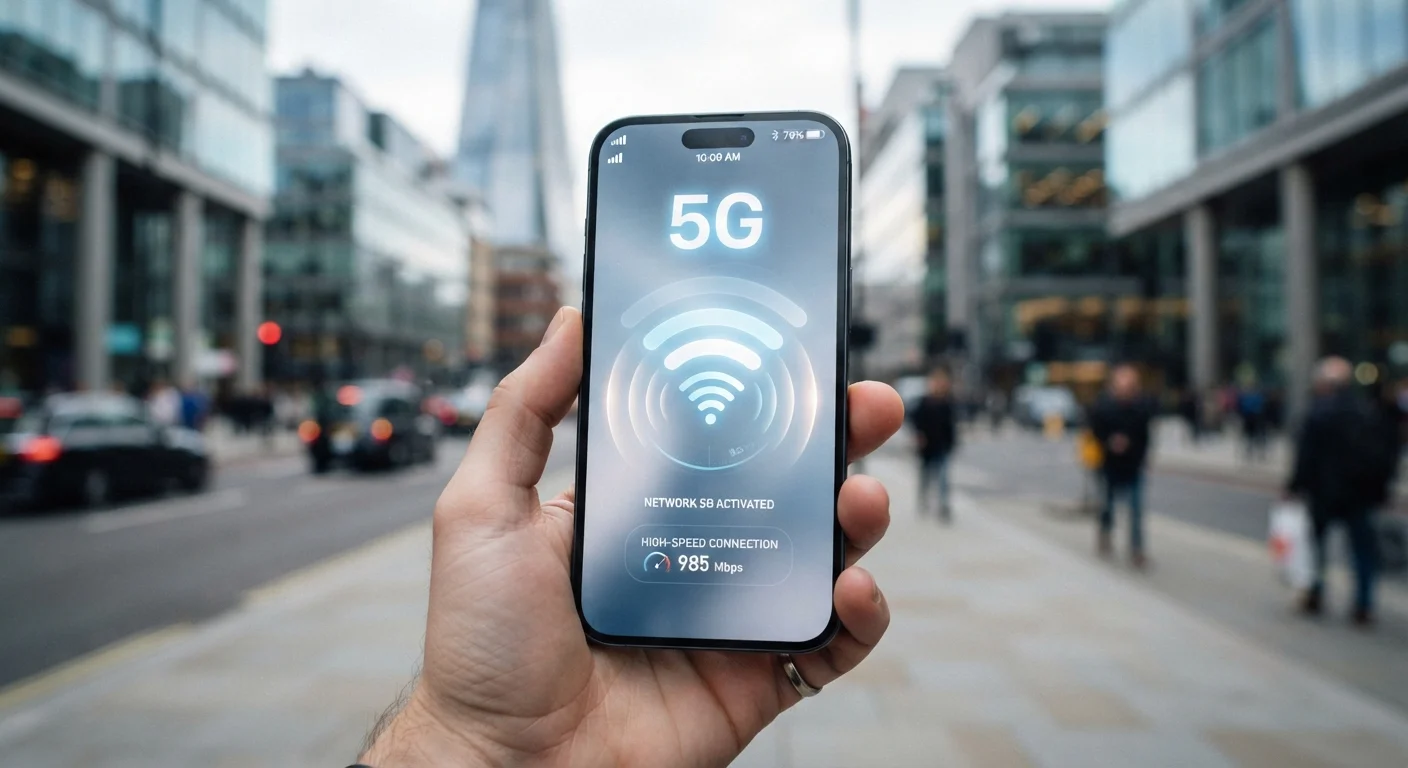
The network icon in the corner of your screen tells you which generation of mobile technology your phone is currently using. What it doesn't tell you is which flavor of 5G you're on — and that distinction matters far more than the label itself.
5G and Wi-Fi Are Separate Systems
5G is a cellular network technology and is unrelated to your home Wi-Fi. When you're connected to Wi-Fi, your phone is not using 5G at all — it routes data through your router instead. The 5G icon only appears when your phone is relying on your carrier's cellular network for data.
For a broader look at how your phone decides between mobile data and Wi-Fi, see our plain-English breakdown of mobile data and Wi-Fi.
The Three Bands of 5G — and Why They Feel So Different
5G operates across three distinct spectrum bands, each with different trade-offs between coverage and speed.
- Low-band 5G travels long distances and penetrates buildings well. It's the most widely deployed type in the US. Speeds are generally modest — often only incrementally faster than a solid 4G LTE connection.
- Mid-band 5G strikes a balance between range and speed. This is where most users experience meaningful performance gains, particularly in cities and dense suburbs. Mid-band is the backbone of what carriers often call "nationwide" 5G in denser markets.
- High-band (millimeter wave) 5G delivers the jaw-dropping speeds seen in demonstrations — but it only works within a short distance of a tower and struggles to pass through walls. It's currently limited to select urban areas and specific venues like stadiums and airports.
3 bands
Distinct 5G spectrum types in US networks
Low-band, mid-band, and high-band (millimeter wave) 5G each offer different speed and coverage trade-offs for consumers.
~200 Mbps
Typical mid-band 5G download speed
Real-world mid-band 5G speeds in well-covered areas often fall in the 100–300 Mbps range, according to independent network testing organizations.
~50 Mbps
Typical low-band 5G download speed
Low-band 5G, the most widely available type, frequently delivers speeds only modestly above 4G LTE averages in practice.
The modem inside your phone — the chip responsible for wireless communication — must support 5G to connect at all. For a deeper look at how that hardware works, see our tour of smartphone hardware.
What 5G Actually Changes for Common Tasks
For the tasks most people do daily, the practical differences are narrower than the marketing implies.
Streaming video: A stable 4G LTE connection is already more than sufficient for HD streaming. 5G may reduce the time it takes to buffer or start a video, but once content is playing, you're unlikely to notice a difference.
Browsing and social media: Web pages and social feeds load quickly on either network under normal conditions. Network congestion — not the generation of technology — is usually what causes sluggishness.
Large file downloads: This is where mid-band 5G shows its value. Downloading a large app update, a podcast, or a high-resolution photo backup will be meaningfully faster on a strong 5G mid-band connection.
Video calls: Latency — the delay between sending and receiving data — is theoretically lower on 5G. In real-world calls, most users won't detect a difference unless the 4G signal is already weak.
Check Your Carrier's Coverage Map
Before assuming 5G is active and performing well in your area, look up your carrier's coverage map and specifically check whether mid-band or only low-band 5G is deployed where you live and work. Many carriers provide this breakdown on their websites. Knowing your band type sets realistic expectations for what you'll actually experience.
What to Know Before Assuming 5G Is Working for You
Seeing a 5G indicator is a starting point, not a guarantee. A few factors determine whether that icon translates into a noticeably better experience:
- Your phone's hardware: Not all 5G phones support every band. Some support only low-band 5G, which caps performance regardless of what towers are nearby.
- Your carrier's network: Coverage, investment in mid-band infrastructure, and local congestion vary significantly between carriers and regions.
- Where you are: Indoor environments, rural areas, and buildings with dense walls can all degrade any wireless signal, including 5G.
It's also worth noting that 5G and Wi-Fi work independently — your phone will typically prefer a known Wi-Fi network over cellular data when available. For more on how those handoffs work, see our explainer on why phones switch between Wi-Fi and mobile data.
This article is for general informational purposes about mobile technology. Network performance depends on many factors specific to your device, carrier, and location.