How Wattage Translates to Monthly Cost
Every electronic device in your home has a wattage rating — a number that tells you how much electricity it consumes while running. Understanding that number is the first step to estimating what your devices actually cost you each month.
The formula is straightforward: multiply the device's wattage by the number of hours you use it per day, then multiply by 30 to get monthly watt-hours. Divide by 1,000 to convert to kilowatt-hours (kWh), which is the unit your utility company bills you for. Finally, multiply by your electricity rate.
Example: A 150-watt television watched 4 hours daily: 150W × 4 hrs × 30 days = 18,000 watt-hours = 18 kWh/month. At the U.S. average residential rate of roughly $0.16 per kWh, that's about $2.88 per month — just for that one TV.
For more on how your devices interact and share power in a connected home, see how modern home electronics work together.
Always-On Devices: The Hidden Drain
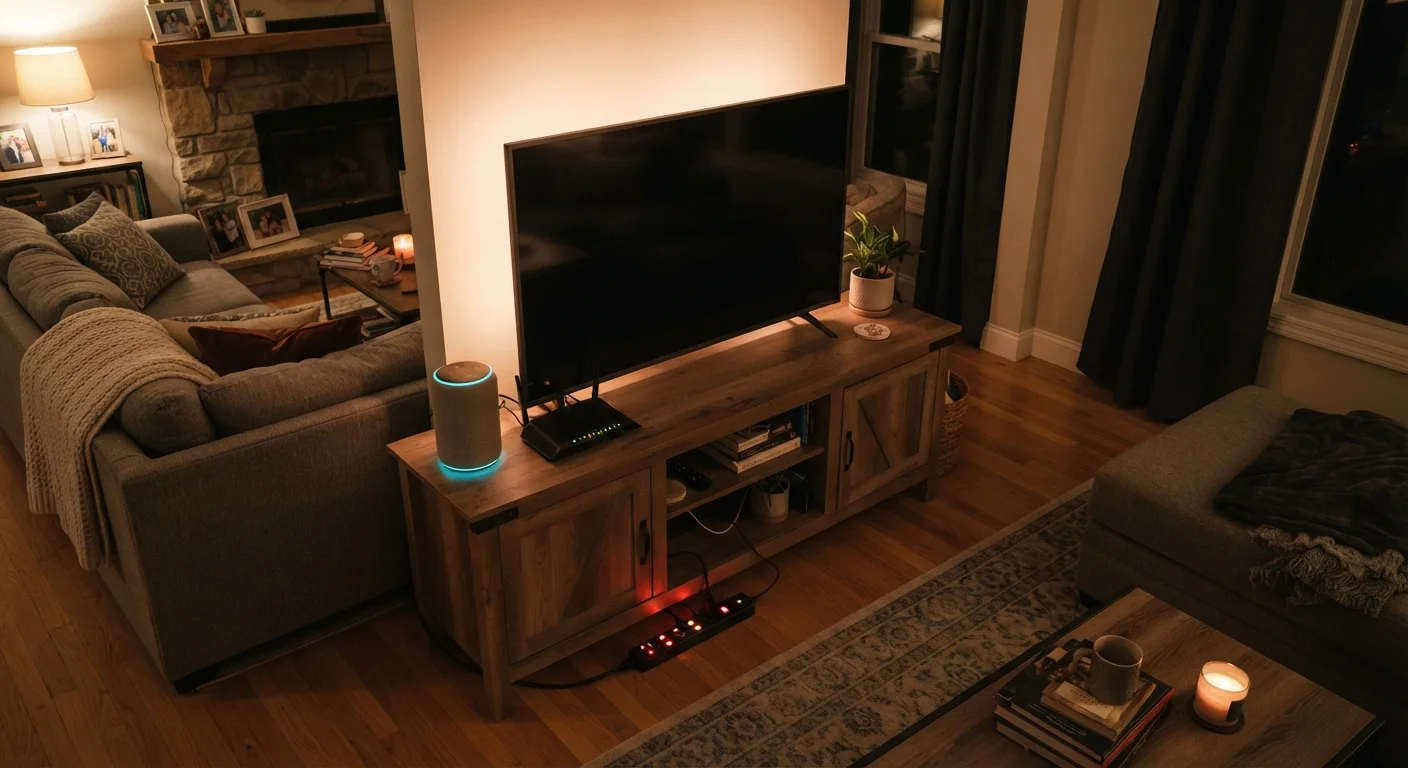
Some devices never fully turn off. Routers, modems, smart home hubs, and cable boxes often run 24 hours a day — and those quiet, continuous draws add up faster than the devices you actively use.
~$100–$200
Annual standby power cost per U.S. household
The U.S. Department of Energy estimates standby power accounts for roughly 5–10% of home electricity use.
5–10%
Share of home electricity from standby devices
Always-on devices like routers, cable boxes, and chargers contribute meaningfully even when not actively used.
20–30%
Potential wattage reduction from lowering TV brightness
Screen brightness is one of the largest variables in a television's actual power draw during use.
A Wi-Fi router typically consumes between 5 and 20 watts continuously. That may sound small, but at 10 watts running constantly: 10W × 24 hrs × 30 days = 7.2 kWh/month. Multiply that across several always-on devices and the total becomes meaningful.
Smart speakers, streaming sticks, and game consoles in standby mode also contribute to what's commonly called vampire power or standby consumption. Learn which devices draw the most power at idle to prioritize where to focus your attention.
Using a smart plug with energy monitoring can reveal exactly how much any individual device consumes — no guesswork required. For more on what smart plugs can and can't do, see smart home devices: convenience and trade-offs.
Reading the Label: Where to Find Wattage
You don't need to guess at wattage — it's printed on most devices. Look for a label on the back or underside of the product. It may list a range (e.g., "20–80W") because energy draw varies by use intensity.
Watt (W)
A unit measuring the rate of electrical energy use at any given moment. A 100-watt device uses 100 watts while running.
Kilowatt-hour (kWh)
The standard billing unit for electricity. One kilowatt-hour equals 1,000 watts used for one hour. This is what appears on your utility bill.
Standby power
Electricity consumed by a device when it is off or idle but still plugged in. Also called vampire power or phantom load.
Typical power consumption
The wattage a device draws under normal, real-world usage conditions — as opposed to maximum or peak draw. Found on spec sheets and product labels.
Vampire power
A colloquial term for the energy devices draw silently when in standby mode. Small individually, but significant when multiplied across a household.
For devices without a clear label, check the user manual or the manufacturer's website. The spec sheet will typically list both typical power consumption and maximum power draw. For budgeting purposes, use the typical figure.
Televisions are one of the larger variables in a household. A 65-inch LED TV generally draws 80–150 watts during active viewing, while an equivalent OLED may draw slightly more. Screen brightness settings affect actual draw significantly — reducing brightness on a TV can lower its wattage by 20–30%.
If you're thinking about the broader financial picture of household costs, the budgeting basics hub offers practical strategies for tracking recurring expenses like utility bills. And for a related look at how upfront savings can mask long-term costs, cheaper household items can cost more over time.
Lighting Is Part of the Energy Picture Too
Bulb wattage follows the same math as any other device. If you're already thinking about electricity costs room by room, it's worth understanding how modern bulb labels work. Home lighting basics: lumens, color temperature, and bulb selection covers how to read bulb labels and choose efficiently for each room.